



How to express probability in English

It’s easy to say “maybe.” It’s harder to say exactly how sure you are.
Are you almost certain? Just guessing? Not convinced it’ll happen? English has different ways to talk about probability, depending on how confident you feel.
Once you get the feel for these, picking the right one becomes second nature.
Sometimes you're fairly confident something is going to happen, but you're not saying it's guaranteed. You want to sound sure, just not absolute.
One of the most common phrases for those moments is "I bet." It sounds confident and conversational at once. You do believe it; you're just not staking your life on it.
A stronger option is "sure to," which feels more definite, though you're still leaving room to be wrong.
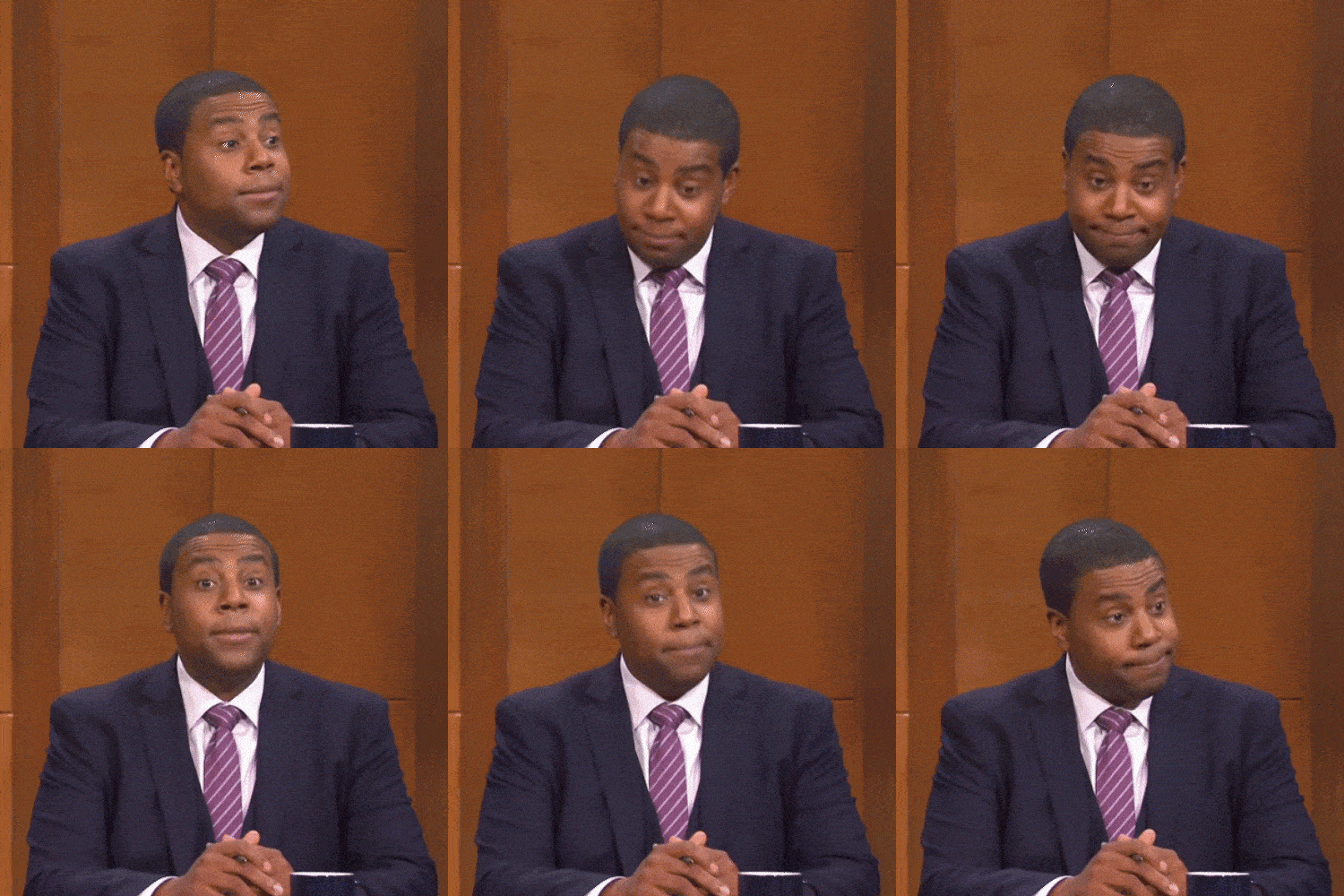
If you want to sound confident without sounding absolute, you can use phrases like "there's every chance" or "more than likely."
For a more formal tone, you might choose "in all probability" or "in all likelihood." You're more likely to see these in writing than hear them in everyday conversation.
Sometimes you think something will probably happen, but you don't want to sound too certain.
Phrases like "odds are" and "chances are" are very common here. Both suggest you think it's likely, but you're not committing to it as a prediction.
You'll also hear "there's a good chance" or "there's a fair chance." All of these sit somewhere between "maybe" and "definitely."
Sometimes you don't think something will happen, but you don't want to say "probably not." There are softer ways to put it.
One option is "hardly likely."
Another common phrase is "I can't see . . .” It keeps it as your view on things, not a verdict.
To talk about a very low probability, you can use "a slim chance" or "an outside chance." A slim chance suggests it's very unlikely; an outside chance is slightly more hopeful, but still unlikely. Both are useful when you want to soften a no.
Sometimes you don't just doubt something. You're convinced it won't happen. There are a few cheeky expressions for that.
One of the strongest is "doesn't have a snowball's chance in hell." It means there's basically no chance, informal and very strong.

Another is "that'll be the day." This one's usually sarcastic. You're saying you don't believe it at all.
For a lighter tone, there's "when pigs fly." It's used for anything you're sure will never happen.
You'll mostly hear all of these in conversation. They're strong, but they're playful too.
Sometimes something happens and you realize you knew it would.
In that moment, you might say "it was bound to happen." It suggests the result didn't surprise you.
If you want to sound even more confident, there's "I saw it coming a mile away." This one's cockier because you're saying the outcome was obvious all along.

Both phrases are informal and usually come after the result is clear, when you're looking back on what happened.
When it comes down to it, you can’t predict the future. No one can. But you can choose how sure you sound. And English gives you a lot of flexibility there. The more range you have, the more natural and confident you’ll come across.















We are committed to equity,
diversity, and inclusion.
We welcome students,
educators, users, researchers,
and employees from a diverse
set of backgrounds.
Our own backgrounds vary in
terms of socioeconomic status,
religion, race, ethnicity,
gender
identity, sexual orientation,
age, neurodiversity,
disability,
and nationality.
In short: Be you. Do you.
We love and embrace
what makes you you. 
Thank you for inviting us to assess
your web copy!
One of our copy analysts will take
a close look at your website and
get back to you right away.
We appreciate your trust.


