



How much is “a lot”? Talking about quantity in English

One of the most frustrating parts of English is talking about amounts.
Do I say much or many? Is it a lot or a few? And what does a lot even mean, really?
How you express quantity depends on what you're describing and what sounds natural in that moment.
When we describe quantities in English, we usually separate things into two groups: things we can count (countable) and things we can't (uncountable).
For instance, apples, books, and people are easy to count. You can have one apple, two books, or five people. On the other hand, words like water, patience, and information can't be counted as individual items. You just talk about having more or less.
That difference helps you decide which quantity words to use.
"Many" is used with things you can count. For example:

But if you try to use "many" with something that isn't countable, it sounds wrong:
How many water do you drink?
People might understand what you mean, but it's not how native speakers normally say it.
The word "much" is used with things you don't count as individual units:
In everyday English, "much" is most common in negative sentences and questions. "I don't have much time" sounds natural. "I have much time" sounds formal or unusual in conversation.
"Many" also shows up a lot in negatives:
⚠️One small thing that often confuses learners is that some words can change depending on how you're using them. For example, "I drank three coffees this morning."
Here, coffee doesn't mean the drink in general. It means servings, or cups of coffee. Once you mean servings, it becomes countable, which is why saying three coffees sounds completely normal.
Unlike much and many, "a lot of" can be used with both countable and uncountable nouns.
Because it works in both cases, learners use it a lot. And that's fine: in conversation, "a lot of" is the default anyway. It sounds natural and informal. In formal writing, you'll see "much" or "many" more often, but in speech, you can't go wrong with it.
Some quantity words aren't only about the amount. They also change how your message feels.
Take "a bit of," for example. It's used with uncountable nouns. The shorter "a bit" also works before adjectives.

Of course, you could be more direct and say, "Can I have ten minutes?" or "I'm very tired." But "a bit" lowers the intensity. It suggests that what you're asking for, or describing, isn't a big deal.
"A little" works in a similar way with uncountable nouns: "We have a little time before the meeting." You'll often hear it as "a little more" when asking for something:
You're still asking for something. The difference is in how it sounds. "This isn't clear" feels too blunt. "A little more clarity" sounds like a small adjustment.
Then there's "a couple of" and "a few," which are used with countable nouns.
Both refer to a small number. "A couple" can literally mean two, but in everyday speech, it often just signals a limited number. Compare these two:
I have five issues to discuss.
I have a couple of things to go over.
The second version feels lighter, even if the actual number isn't much smaller.
You'll also hear "a drop of," usually with liquids.
No one expects a literal measured drop. It simply emphasizes how little you want.
These kinds of phrases are common because they soften what you're saying. They make requests, feedback, and small problems sound less intense and less confrontational.
Sometimes you don't just want to describe a big amount. You want it to feel reassuring, generous, or impressive.
Start with "plenty of."
"Plenty of" suggests more than enough for the situation. When you say, "There's plenty of time," you're not just describing the amount. You're easing someone's concern.

Then there are expressions like "lots of," "tons of," "loads of," and "heaps of." Like "a lot of," they can be used with both countable and uncountable nouns.
All of these point to a large amount, but they don't feel exactly the same. "Lots of" is neutral and very common. "Tons of" and "loads of" sound more informal and enthusiastic. "Heaps of" is more common in British and Australian English than in American English.
These expressions often exaggerate slightly, and that's normal. When someone says, "We've got tons of time," no one imagines literal tons! It simply means there's far more time than needed.
Not all quantity words describe size. Some simply leave the amount open.
The word "some" is the most familiar example. It can be used with both countable and uncountable nouns:
In these sentences, "some" doesn't tell you whether the amount is small or large. It just means an unspecified quantity.
You'll also hear it often in offers and requests:
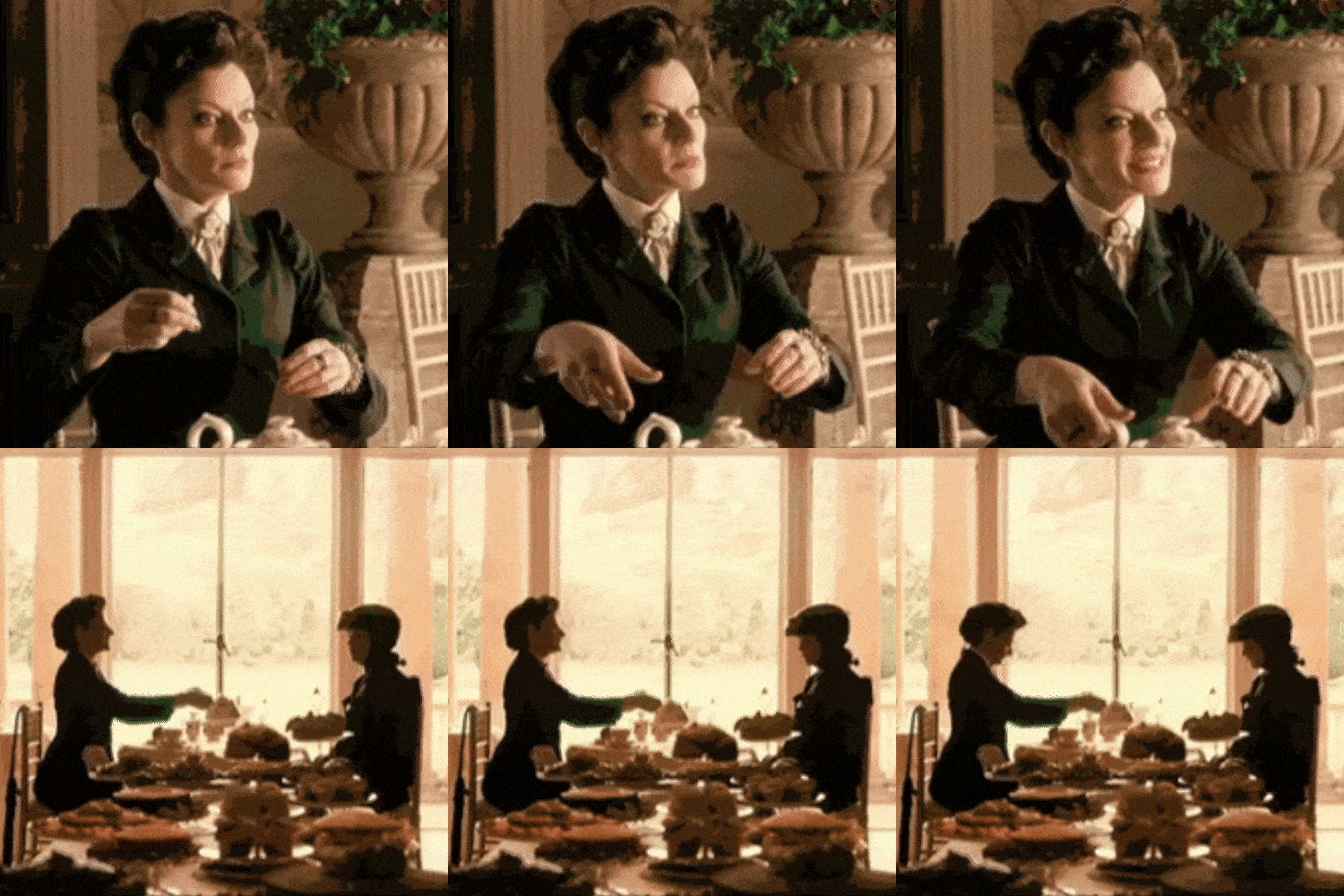
The person offering doesn't need to specify a number, and the person accepting doesn't need to commit to one.
All of this might feel like a lot to take in, but you don't need to remember everything at once. When you're unsure, start simple. Look at the noun. Can you count it or not? Then think about what you're trying to express. A small amount? A large one? Something neutral or flexible?
From there, the options narrow quickly. The more you hear these patterns in real conversations, the more natural your choices will become















We are committed to equity,
diversity, and inclusion.
We welcome students,
educators, users, researchers,
and employees from a diverse
set of backgrounds.
Our own backgrounds vary in
terms of socioeconomic status,
religion, race, ethnicity,
gender
identity, sexual orientation,
age, neurodiversity,
disability,
and nationality.
In short: Be you. Do you.
We love and embrace
what makes you you. 
Thank you for inviting us to assess
your web copy!
One of our copy analysts will take
a close look at your website and
get back to you right away.
We appreciate your trust.


