



You have access to online tools. Now what?

If you want to improve your English today, you don't have to look far.
You can book a lesson with a native speaker in minutes, use AI tools to check your writing, join international meetings with built-in subtitles, and connect with people across the world. All without leaving your desk. The tools are there. The access is there.
That's not the problem anymore.
The real question isn’t whether you can improve, but rather what you’re doing with the access you already have
Most global communication happens online now. And like it or not, English is still the default language in a huge portion of those spaces, from professional content and tools to communities and conversations.
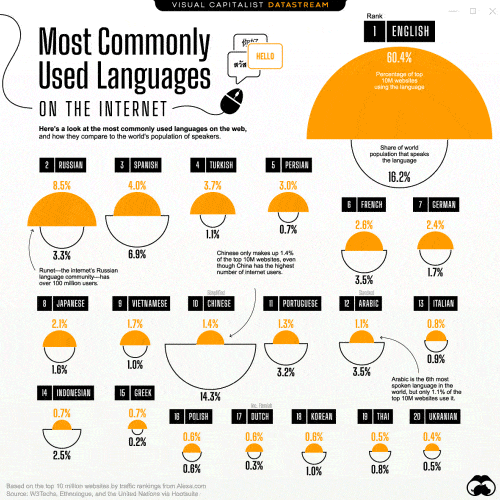
"Most commonly used languages on the internet" by Visual Capitalist
So if you want to participate fully, English is, more than anything else, access.
And the good part is obvious: the same internet that made English unavoidable also made it easier to learn.
Learning English has never been more accessible. The tools available today have removed most of the barriers that were there before.
The cost came down
You no longer need to commit to a long-term in-person course to get started. Tutors are available at different price points, and language exchange apps connect you with native speakers for free. Not to mention podcasts, YouTube channels, and open online courses that put high-quality input within reach.

Location stopped being a limitation
The teacher in your city and the materials in your local bookstore used to be your main options. Now you can book a session with a tutor on the other side of the world, join a webinar, or attend a virtual workshop from almost anywhere.
Feedback got faster
AI writing tools flag awkward phrasing instantly. Translation platforms let you compare structure and wording in seconds. And video lets you replay, pause, and analyze real conversations instead of relying on static textbook examples.
Exposure became constant
English appears in your LinkedIn feed, industry podcasts, global team chats, webinars, and online communities. If you choose to engage with it, you're surrounded by real, professional English every day.
That combination of lower cost, wider access, faster feedback, and constant exposure changed the baseline. For the better.
Online tools can take you far. But they only work if you use them with intention. Here's what that looks like in practice.
Use AI as a learning tool, not a shortcut
AI writing tools and translation platforms are useful, but the real value comes from how you engage with them. Instead of copying corrections and moving on, compare versions and look closely at what changed. If a sentence was restructured, rewrite it yourself. If a word was replaced, ask whether the tone shifted. Used that way, AI becomes feedback rather than automation.
Prioritize active practice
Watching English content builds exposure, but fluency develops when you actually produce language. That means speaking in meetings even when it feels uncomfortable, writing without immediately translating, or summarizing what you've watched instead of just consuming it. The more actively you use the language, the faster patterns become automatic.
Focus on specific weak spots
Online platforms let you personalize your practice, but that only works if you know what needs improving. For German speakers, that might mean adjusting word order in longer sentences, softening direct phrasing in professional emails, or working on pronunciation patterns that don't exist in German. Targeted effort leads to measurable progress.
Add human feedback
Technology accelerates practice, but precision often needs another perspective. A tutor, a structured session, or professional corrections can surface recurring patterns you don't notice yourself. Even occasional feedback can stop small habits from becoming permanent ones.

At this point, if you’re online, chances are English is already part of your day. It’s in your inbox, your meetings, your feeds, your research. You’re already logging in. You’re already exposed to it.
You don’t need more access. You just need a clearer way to use it.















We are committed to equity,
diversity, and inclusion.
We welcome students,
educators, users, researchers,
and employees from a diverse
set of backgrounds.
Our own backgrounds vary in
terms of socioeconomic status,
religion, race, ethnicity,
gender
identity, sexual orientation,
age, neurodiversity,
disability,
and nationality.
In short: Be you. Do you.
We love and embrace
what makes you you. 
Thank you for inviting us to assess
your web copy!
One of our copy analysts will take
a close look at your website and
get back to you right away.
We appreciate your trust.


