



Why English matters beyond the classroom

Most students spend years in English class without ever being told why it matters beyond passing exams. The truth is, it’s more than just another school subject. It’s a practical skill that expands what you’re able to do in real life.
Over 1.5 billion people speak English globally. That makes it the closest thing we have to a universal language. But the real question is what that access gives you.
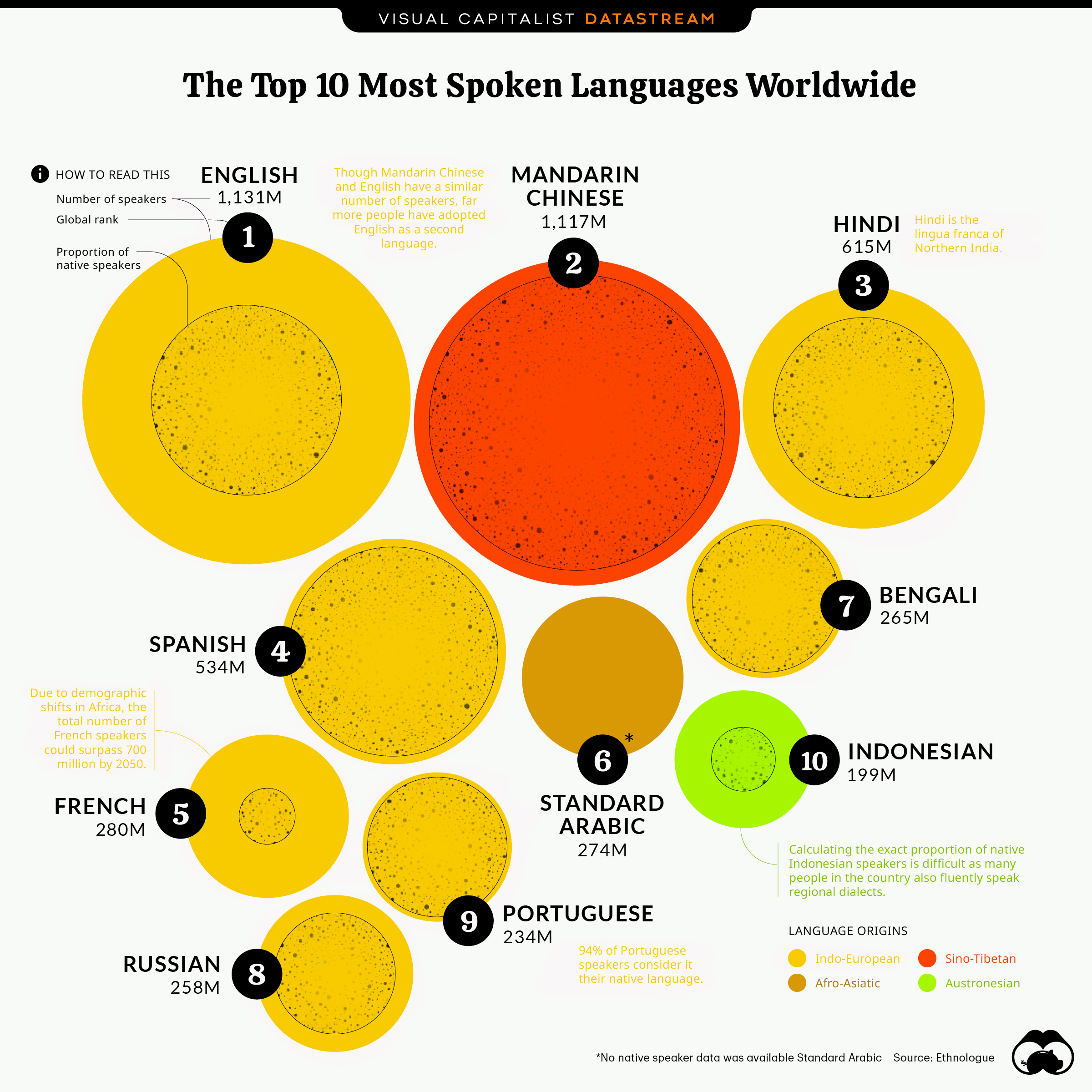
"The Top 10 Most Spoken Languages Worldwide" by Visual Capitalist, Recolored from original
English is widely used as a common working language in international business. And it’s not a matter of preference or cultural dominance. It’s simply the most convenient option. When a German engineer needs to collaborate with a Brazilian supplier and a Japanese investor, they probably won't learn three new languages. They’ll just use English instead.

That reality has real career consequences. Many companies consider English ability during hiring, especially for international roles. Your resume might be brilliant, but if you can't join a video call with the London office, you're out.
English is the dominant language of international academic publishing. If you're studying medicine, engineering, psychology, or almost any field that involves staying current, you need English to access new findings.
This goes beyond reading papers. Conferences, expert networks, online courses from top universities . . . they're mostly in English. You can wait for translations, but by the time they arrive the conversation has usually moved on.
Of course, English won't help you order coffee in rural Portugal, but it will get you through airports, help desks, and tourist information centers almost anywhere. A large portion of online information is available in English, making it useful for travel planning and research.
Travelers sometimes overpay for things simply because they couldn't negotiate or ask clarifying questions. Even basic English makes those situations much less risky.
The bulk of coding documentation and developer resources live in English. Programming languages, documentation, error messages, developer forums . . . mostly English by default.

You can learn to code without strong English skills, but you'll hit a ceiling quickly. When something breaks and you need to search Stack Overflow or read GitHub discussions, you're navigating an English-first environment. Sure, you can work around it, but it slows everything down.
Research keeps pointing to the same thing: better English often means a bigger paycheck. Studies from Cambridge English show that employees fluent in English often earn notably more than colleagues with similar skills who lack language proficiency.
This makes sense when you consider job mobility. English speakers can apply for positions across more companies, industries, and countries. That expanded opportunity set gives you leverage when negotiating salary or considering offers.
The better your English, the more comfortable you feel joining in and expressing yourself at work. It’s pretty straightforward: when you can express yourself clearly in the world's most widely used professional language, you stop avoiding situations where you'd need to speak up.
From public speaking and leading meetings to representing your team to external stakeholders, these opportunities stop feeling threatening when language isn't a barrier.

English proficiency isn't about sounding sophisticated or impressing anyone. It's about removing friction from things you'll want to do anyway. Ultimately, it influences your career prospects, access to information, independence while traveling, comfort with technology, and social reach.
The classroom teaches grammar and vocabulary. The real world tests whether you can use the language to get things done. They’re related skills, but the second matters more than most curricula admit.















We are committed to equity,
diversity, and inclusion.
We welcome students,
educators, users, researchers,
and employees from a diverse
set of backgrounds.
Our own backgrounds vary in
terms of socioeconomic status,
religion, race, ethnicity,
gender
identity, sexual orientation,
age, neurodiversity,
disability,
and nationality.
In short: Be you. Do you.
We love and embrace
what makes you you. 
Thank you for inviting us to assess
your web copy!
One of our copy analysts will take
a close look at your website and
get back to you right away.
We appreciate your trust.


